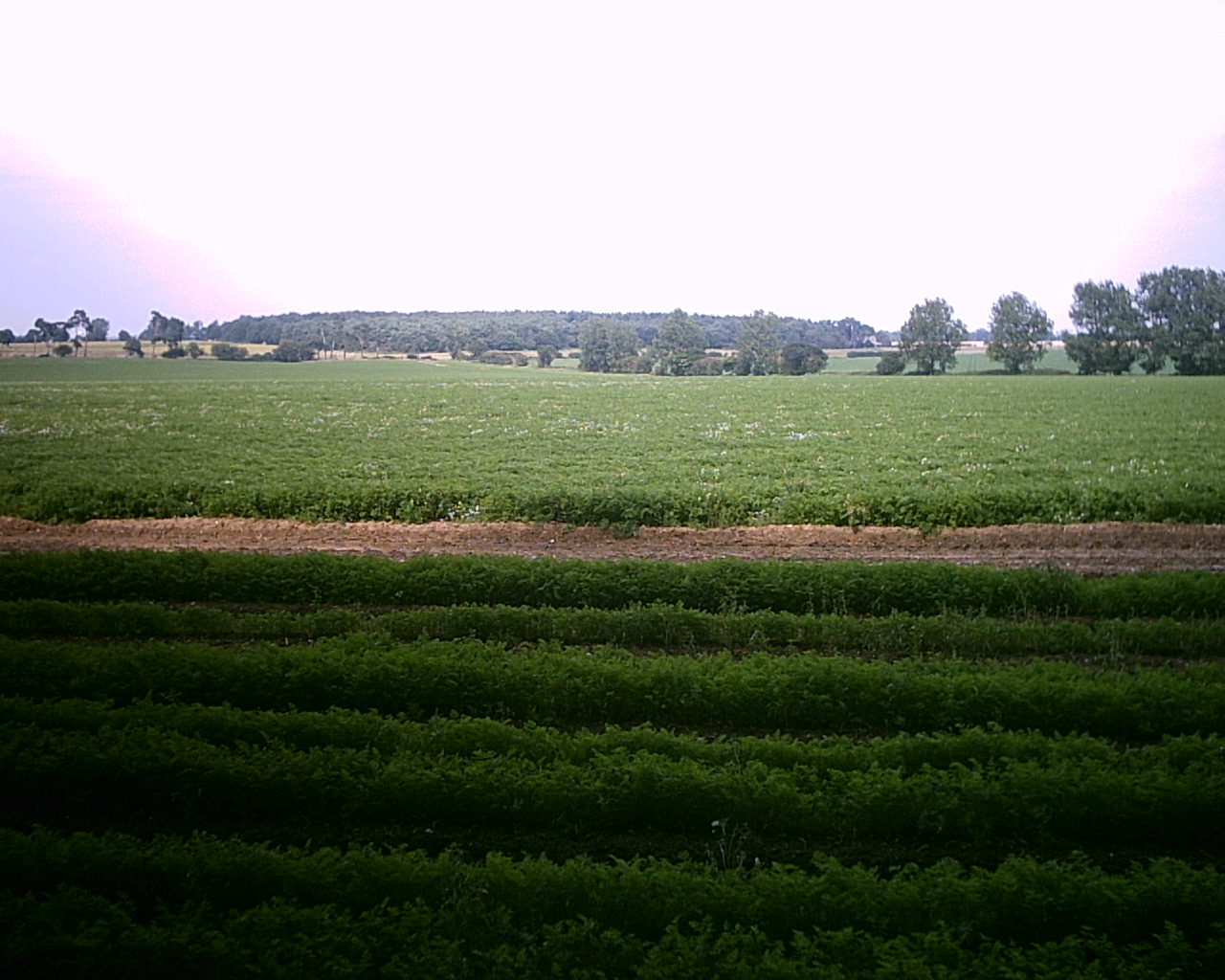
A modern Longhorn Cow and Calf [1]
In recent days, I have found the following description of one of my maternal 4 x gt grandfather William Greatorex's (1742-1822) cows.
The cow was an "Old Longhorn Cow" which came from a breed that is seen today as being endangered because is some rare these days. These cattle were probably the origin of the far more common Texas Longhorn, but the two breeds have both diverged from their common roots.
The situation for Longhorns in England had become absolutely critical about 30 years ago, when they nearly disappeared. My parents and I were fortunate enough to live near to two of the very few remaining herds that were then in existence, and so we used to see them often, and my mother used to visit them to draw them. They became firm family favourites.
It is quite sad not to be able to tell my late mother that her great great great grandfather had had these cows on his farm, as she was quite passionate about them.
The description of the cow comes from a book called General View of the Agriculture and Minerals of Derbyshire: with ..., Volume 3, by the Board of Agriculture, written by John Farey and printed in 1817.
Sadly, I cannot date the life of this cow precisely, however it was probably born in about 1798 and and would have lived throughout most of the Napoleonic War period.

The original description of the cow in John Farey's work. [2]
I have been aware that my maternal ancestors from the Greatrex (or Greatorex) family [4] had lived at Littleover in Derbyshire for several years, after finding an entry in the Census Reports for my great x 3 grandfather, Francis Greatrex who was then living in Hornsey.
I had been unable to locate his parents farm, as I did not know its name, and had been searching unsuccessfully in the centre of village of Littleover itself, which was where I had been expecting to find the farm.
Having the actual name of the farm has finally allowed me to locate the correct farm at Littleover.
The farm went by the rather unprepossessing name "Foulbrook Farm" and was located well away from the actual village of Littleover itself, in a position right up against the parish boundary on the Uttoxeter Road as it comes out of Derby right on the boundary between the villages of Littleover and Mickleover.
I had been unable to locate his parents farm, as I did not know its name, and had been searching unsuccessfully in the centre of village of Littleover itself, which was where I had been expecting to find the farm.
Having the actual name of the farm has finally allowed me to locate the correct farm at Littleover.
The farm went by the rather unprepossessing name "Foulbrook Farm" and was located well away from the actual village of Littleover itself, in a position right up against the parish boundary on the Uttoxeter Road as it comes out of Derby right on the boundary between the villages of Littleover and Mickleover.

An extract from the 1899 Edition of the Ordnance Survey Map of Derby. [3] (For a larger version of this image and any of the others, please click on this image)

A side by side version of the images, showing the relationship with modern maps.
It also shows just how much Derby has grown since 1899. In 1800, when this cow grew up Derby only had a population of between 11,000 and 13,000, so that it had been very much smaller still. Many of the houses shown on 1899 map had been built over fields which had been full of cows and horses when William was farming here.
Farey makes it clear that dairy farming was the major farming occupation in Derbyshire. He states that farmers within two to three miles of Derby were able to make the highest achievable income per acre from their farms by selling their milk to the households of Derby, and this is what the description of the cow suggests William Greatrex was doing.
Most farmers in the more rural areas of Derbyshire were unable to transport their milk into Derby quickly enough for it to arrive in a saleable state in the form of milk due to the dire state of the roads. It would be very difficult to stop the milk going off or separating due to the jolts it would have been subject to as it travelled to the town in churns on pack horses or in carts.
These farmers had to convert their surplus milk into cheese, which could be transported more easily without going off, and which could be sold at one of the three major fairs held annually in Derby at which cheese was sold. It is possible that William Greatrex may also have supplied butter and cheese to Derby.
At the commencement of the 19th Century, a cow worth £4 to £6 was expected to be able to make £26 of annual income for the farmer, compared with only £20 if the milk had to be made into cheese. [5]
The surveys by the Board of Agriculture of the farming in each county were started by Arthur Young (1741 - 1820) who was small scale struggling farmer from Suffolk, who eventually became a hobby farmer and journalist on agricultural matters. He wrote thousands of letters to farmers all over England inclosing questionnaires from about 1805 onwards. This led to his becoming a highly successful author and advisor on farming matters.
As a young man Young was a close neighbour of my Rodwell ancestors who lived just north of Bury St Edmunds at Great Livermere. Young was the second son of Arthur Young, the rector of Bradfield Combust, which was just ten miles away. Young corresponded later on with both my gt x 4 grandfather Josiah and my 3 x gt grandfather Joshua Rodwell (from my paternal family tree) who were both improving Suffolk farmers.
Some of these letters still survive and I have found some of them in the British Library. Extracts of others appear marked "J.R." in the footnotes in the Suffolk volume of the survey.
John Farey (Senr) who wrote the three volumes on Derbyshire took over Arthur Young's role at the Board of Agriculture. He was not primarily a farmer, but a Surveyor. He worked for the Duke of Bedford who lived at Woburn in Bedfordshire.
The Duke had a huge estate encompassing Woburn and several neighbouring villages so Farey had an excellent job, with very great responsibilities. He had previously trained in surveying under John Smeaton who was the most important of the newly emerging professional Civil Engineers.
The Duke was interested in Geology, so he had invited William "strata" Smith, who was the first man to understand the importance of strata and the new science of Geology to inspect the Duke's estate and to report on any minerals that might be present under it.
Smith was a self taught geologist, who had been a foreman on a gang of navvies digging canals in Somerset near Bath.
The geology is really complex in the Somerset Coalfields, and from observing the changing layers in the muck as they were uncovering as he and his men were shifting it to construct the canals he had learnt how strata worked. Smith at his own expense then set off for many years to walk from one end of the British Isles to the other mapping the surface geology, and from these notes he produced the very first geological map of England.
Apparently Smith interested Farey in geology by showing him how the geology worked on the Woburn Estate.
Farey then used this knowledge to good effect in his work on the three volume Survey Derbyshire, which started in 1811, which includes a great deal on the mineral wealth of Derbyshire.
I am trying to track down the report by Thomas Brown the text refers to.
The yields are not easy to convert into metric, as some special measures were used that were unique to the wholesale milk trade in those days.
A barn gallon equalled 17 pints.
A normal gallon equals 8 pints (or at least it did when I was at school.)
A barn gallon equalled 2 Imperial gallons.
A barn gallon equalled a dozen quarts
The 17th pint in the barn gallon was supposed to compensate the milk man for the milk that had adhered to the sides of the farmers barrel or to the milk mans jug when he had poured the milk into the jug as he delivered it the Derby housewife.
The concept was a bit like that of a "Bakers Dozen." made up of 13 buns rather than say 12 eggs in a dozen.
I expect that poor cow was a very poor producer by the standards of today. However, in the early 19th Century Longhorns were seen as a very advanced breed.
Robert Bakewell who had started to revolutionise the breed (which is believed to have originally come from Westmoreland, where my Nicholson ancestor's almost certainly bred them at Kirby Thore) lived only 17 miles to south of Littleover at Dishley near Loughborough on the main road from Derby to London which is called the A6 today.
There was a lot of controversy at that time amongst the general run of farmers, and the "Improving Farmers" like Bakewell, over the relative importance of characteristics like producing more milk, or more meat, or even its hauling ability, over which characteristic should be the primary aim in developing new cross breeds at that time.
Some farmers feared that the newly bred cattle varieties would require better grazing than the older unimproved Longhorns needed. I expect that William Greatorex was still using the old unimproved variety.
The following photo shows the location of the farm. Sadly today it almost entirely lies under the asphalt of the public car park at Derby General hospital. While I might like to get an archaeological dig underway to find the farm, I don't think I could mobilise quite the level of interest that was behind the recent campaign to undertake an excavation under the car park in Leicester. [6]

The original farm was only about 30 acres, which was a small farm in the 18th Century and one that was only just viable as a farm at that time and in this area.
William Greatrex was a tenant farmer who rented his farm from a Charity called Houghton's Charity.
Many villages and towns had received bequests of land in the Tudor or even Medieval period, which were used to fund charitable work for the destitute or for things like providing education to villagers.
When villages were enclosed, it was common for these charities to receive small packages of land on the outskirts of the villages as compensation. It appears that Foulbrooke Farm was one of these farms.
As the following advertisement from the Derby Mercury in December 1796 shows, William was the sitting tenant.

Advertisement for Letting the Farm in 1796. [7]
On 1st of October 1789, William Greatorex at Foulbrooke was listed as having a Game License. This may have been at the commencement of the previous seven year period of his tenancy.
In notices of his death in 1822, he was stated to have been 80 years old. This would mean that in 1789 he would have been 47 years old. I have been unable to trace the history of the farm at an earlier date, however he might have had the tenancy over several of the previous seven year tenancy periods.
Was he farming at Foulbrooke from about 1760?
He was able to secure the farm once more in 1796.
It appears that William Greatorex had had some standing in the local community. In the absence of a police force, life was often very difficult for farmers, who were frequently robbed on their way back from market of the cash they were known to be carrying. Their farms and livestock were very often plundered for valuable animals, in times of shortage by local villagers or by gangs from the nearby towns.
In order to protect themselves farmers would band together to form Societies for the Apprehension of Felons. The members of these societies would join together to offer rewards for the tracking down and prosecution of thieves who had attacked one of their members persons or property. They organised search and pursuit parties in some cases.
Several of my Suffolk farming ancestors were stalwarts of these Societies, which held bi-annual dinners in local pubs, like the Fox at Barking.
I think that it is possible that William Greatrex was in one of these associations, as on Thursday February 2nd, 1792 the following advertisement was placed in the Derby Mercury.

Note how his name is given as Greatrex. Presumably William had given the newspaper office the text of this advertisement, and therefore must have approved of its spelling.
What was a Red Stag doing in Mr Wade's barn? In those days the ownership of stags, dead or alive was fairly restricted. Does anybody know who Mr Wade was, or where he came from?
I believe that William's wife was called Elizabeth. We don't know when she was born, or when they married, or even what her maiden name had been.
One possibility, is that it was Banning, and that she may have come from White House in Ticknell, which is a farm a little to the east of the village of Ticknell. We have in our possession several letters from this address from an Ann Banning, who appears to have been a relative of the family.
Elizabeth lived until August 1839, which is 17 years after her 80 year old first husband had died.
What was a Red Stag doing in Mr Wade's barn? In those days the ownership of stags, dead or alive was fairly restricted. Does anybody know who Mr Wade was, or where he came from?
I believe that William's wife was called Elizabeth. We don't know when she was born, or when they married, or even what her maiden name had been.
One possibility, is that it was Banning, and that she may have come from White House in Ticknell, which is a farm a little to the east of the village of Ticknell. We have in our possession several letters from this address from an Ann Banning, who appears to have been a relative of the family.
Elizabeth lived until August 1839, which is 17 years after her 80 year old first husband had died.
I think that she might have been a much younger than he was, because in June 1831, she was still seen as being a lady who was eligible for marriage. Possibly, she had been William's second wife.
"Yesterday morning, at St. Peter's Church, by the Rev. Mr. Frizell, Mr. Thomas Richardson, of Littleover, to Mrs. Elizabeth Greatorex, late of Foulbrook House, near this town."[9]
We know that this Elizabeth Greatorex was originally William's wife as this fact is referred to in the notices published in the Derbyshire Courier on the 17th of August 1839 following her death.
"Yesterday morning, at St. Peter's Church, by the Rev. Mr. Frizell, Mr. Thomas Richardson, of Littleover, to Mrs. Elizabeth Greatorex, late of Foulbrook House, near this town."[9]
We know that this Elizabeth Greatorex was originally William's wife as this fact is referred to in the notices published in the Derbyshire Courier on the 17th of August 1839 following her death.
"At Long Eaton, a few days since, Mrs. Richardson, relict of the late Mr. Greatorex, of Foulbrook Farm, near Derby." [10]
An interesting advertisement appeared in the Derbyshire press in January 1831, which suggests that the farm carried a lot of trees during William's time.

Advertisement for the sale of trees from Foulbrooke Farm, January 26, 1831. [11]
The fact that a 30 acre farm was carrying 119 trees must have meant that it was fairly well wooded. I have no idea how many cows, and horses the farm was carrying, but this number of trees must have taken up quite a lot of room, and have shaded a lot of the grazing.
There are some other tantalizing bits of evidence that the family were farming land in at least two other locations nearby.
In 1824 the road from Uttoxeter to Derby that ran past Foulbrooke Farm into Derby was realigned as it entered Derby.
The following extract comes from a much longer advertisement placed in the Staffordshire Advertiser dated Saturday 28th August 1824, as the process of getting access to the land was carried through.
"NOTICE IS HEREBY GIVEN, Application is intended to be made to Parliament in the next ensuing Session, for leave to bring in a Bill for repealing an Act passed in the year the Reign of his late Majesty King George the 3d, intituled an Act for reviving the term, and continuing, altering and enlarging the powers two Acts passed in the 32nd year of his late Majesty, and in the third year of his present Majesty, so far as the same relate to repairing and widening the Road from the town of Derby, to the town of Uttoxeter, in the county of Stafford, and for granting further and more effectual powers and provisions for amending, widening, diverting, altering and otherwise improving the said Road,in which Bill provision is intended to be made for making a new Branch of Road commencing from the said Road at or near to a certain house in Stockbrook Field, in the parish of Saint Werburgh, in the borough of Derby, in the occupation of Joseph Harpur, and passing along or near to a certain Lane there called Dayson Lane, to and into the town of Derby, or near Saint Werburgh's Church. Also a deviation from the said Road commencing at or near to the south east corner of piece of land called the Near Booth Close, in the parish of Markeaton, in the county of Derby, in the occupation of the Executors of the late John Wallis, and extending in a westwardly direction to and into the said Road at or near the westwardly end of a piece of land called the Paddock, in the said parish of Markeaton, in the occupation of Elizabeth Greatorex. Also another deviation from the said Road commencing at or near the southeastwardly corner certain piece of land called the Intake, in the parish of Mickleover, in the county of Derby, in the occupation of John White, and extending in westwardly direction to and into the said Road at or near to the southwestwardly corner a certain piece of land called the First Day's Close, in the said parish of Mickleover, in the occupation of the said John White. "[11]
I cannot presently identify the location of "a piece of land called the Paddock, in the said parish of Markeaton, in the occupation of Elizabeth Greatorex" and I would be very pleased if any body reading this blog is able to locate the field. I am intrigued to know where it was, and how big it was.
When William Greatrex's death was announced in the Monthly Magazine, or, British Register, in 1822 it was in the following terms...
“At Foulbrook Farm, near Derby, 80, Mr. Greatrex, well known for many years to the sporting world" [12]
It is hard to be certain what was meant by the sporting world, however I believe it is a reference to horse racing. One of William's sons, John Greatrex became a very successful breeder and trainer of thoroughbred horses including Pocahontas during the 1830's and 40's. [13]
One of his other sons, Francis who I am descended from was considerably less successful with horses, however he still appears to made much of his living from working with horses, as he is listed as a commission salesman for horses, and also as running a livery stable in Islington, with a small rented farm at Hornsey Lane.
It is very likely that William Greatrex was training horses on his land. There are quite a few references to a Mr Greatrex running horses at racing courses like Lichfield, Leicester and Newmarket during the period when William Greatrex was likely to have been most active as a trainer, however because the papers refer to Mr. Greatrex, without giving his christian name it is not possible to be certain, which Mr Greatrex it was, and there were several other possible Mr Greatrex alive at this time.
"Mr. Greatorex’s chef. Colt, Cannon-Ball came third." in the Leicester Races in 1781. [14]
and "Mr. Greatex’s chestnut gelding, Harold, 5 years", that was running in the Newmarket Second October Meeting on Wednesday October 18, 1786. [15]
If I am correct in assuming that William was the Mr. Greatorex or Greatrex who was training race horses, it is very likely that he had access to other parcels of land rented nearby.
There are other indications, that this was so.
After William had died it appears that at least two of his sons tried to run farms of their own in the Littleover area. A Charles Greatrex was farming in Littleover a decade or more later in the 19th Century.
My own forebear Francis Greatrex appears to have continued to have run the milk delivery side of the business after his father's death, as he had been renting three small paddocks of land at Dunkirk in the Parish of St Werburgh's in Derby up and until shortly before April 1827, by when he had left for London.
There are some other tantalizing bits of evidence that the family were farming land in at least two other locations nearby.
In 1824 the road from Uttoxeter to Derby that ran past Foulbrooke Farm into Derby was realigned as it entered Derby.
The following extract comes from a much longer advertisement placed in the Staffordshire Advertiser dated Saturday 28th August 1824, as the process of getting access to the land was carried through.
"NOTICE IS HEREBY GIVEN, Application is intended to be made to Parliament in the next ensuing Session, for leave to bring in a Bill for repealing an Act passed in the year the Reign of his late Majesty King George the 3d, intituled an Act for reviving the term, and continuing, altering and enlarging the powers two Acts passed in the 32nd year of his late Majesty, and in the third year of his present Majesty, so far as the same relate to repairing and widening the Road from the town of Derby, to the town of Uttoxeter, in the county of Stafford, and for granting further and more effectual powers and provisions for amending, widening, diverting, altering and otherwise improving the said Road,in which Bill provision is intended to be made for making a new Branch of Road commencing from the said Road at or near to a certain house in Stockbrook Field, in the parish of Saint Werburgh, in the borough of Derby, in the occupation of Joseph Harpur, and passing along or near to a certain Lane there called Dayson Lane, to and into the town of Derby, or near Saint Werburgh's Church. Also a deviation from the said Road commencing at or near to the south east corner of piece of land called the Near Booth Close, in the parish of Markeaton, in the county of Derby, in the occupation of the Executors of the late John Wallis, and extending in a westwardly direction to and into the said Road at or near the westwardly end of a piece of land called the Paddock, in the said parish of Markeaton, in the occupation of Elizabeth Greatorex. Also another deviation from the said Road commencing at or near the southeastwardly corner certain piece of land called the Intake, in the parish of Mickleover, in the county of Derby, in the occupation of John White, and extending in westwardly direction to and into the said Road at or near to the southwestwardly corner a certain piece of land called the First Day's Close, in the said parish of Mickleover, in the occupation of the said John White. "[11]
I cannot presently identify the location of "a piece of land called the Paddock, in the said parish of Markeaton, in the occupation of Elizabeth Greatorex" and I would be very pleased if any body reading this blog is able to locate the field. I am intrigued to know where it was, and how big it was.
When William Greatrex's death was announced in the Monthly Magazine, or, British Register, in 1822 it was in the following terms...
“At Foulbrook Farm, near Derby, 80, Mr. Greatrex, well known for many years to the sporting world" [12]
It is hard to be certain what was meant by the sporting world, however I believe it is a reference to horse racing. One of William's sons, John Greatrex became a very successful breeder and trainer of thoroughbred horses including Pocahontas during the 1830's and 40's. [13]
One of his other sons, Francis who I am descended from was considerably less successful with horses, however he still appears to made much of his living from working with horses, as he is listed as a commission salesman for horses, and also as running a livery stable in Islington, with a small rented farm at Hornsey Lane.
It is very likely that William Greatrex was training horses on his land. There are quite a few references to a Mr Greatrex running horses at racing courses like Lichfield, Leicester and Newmarket during the period when William Greatrex was likely to have been most active as a trainer, however because the papers refer to Mr. Greatrex, without giving his christian name it is not possible to be certain, which Mr Greatrex it was, and there were several other possible Mr Greatrex alive at this time.
"Mr. Greatorex’s chef. Colt, Cannon-Ball came third." in the Leicester Races in 1781. [14]
and "Mr. Greatex’s chestnut gelding, Harold, 5 years", that was running in the Newmarket Second October Meeting on Wednesday October 18, 1786. [15]
If I am correct in assuming that William was the Mr. Greatorex or Greatrex who was training race horses, it is very likely that he had access to other parcels of land rented nearby.
There are other indications, that this was so.
After William had died it appears that at least two of his sons tried to run farms of their own in the Littleover area. A Charles Greatrex was farming in Littleover a decade or more later in the 19th Century.
My own forebear Francis Greatrex appears to have continued to have run the milk delivery side of the business after his father's death, as he had been renting three small paddocks of land at Dunkirk in the Parish of St Werburgh's in Derby up and until shortly before April 1827, by when he had left for London.

Advertisement for the sale of land formerly rented by Francis Greatrex, milkman.[16]
The location of these three closes is intriguing because if you carry on down the Uttoxeter Road from Foulbrooke Farm past the paddock previously referred to at being located in Markeaton, you arrived in 1826 at Dunkirk Farm which was on the outskirts of Derby.
In 1765 it was described as being fit for a Gentleman's family,
In 1765 it was described as being fit for a Gentleman's family,
"with convenient Offices, Stables, Garden, Coach House, and a Seat in St. Weburgh's Church. And also a House, Tan yard, two Cottages, and nine Acres of Meadow, and Pasture land, called Dunkirk Farm." [17]
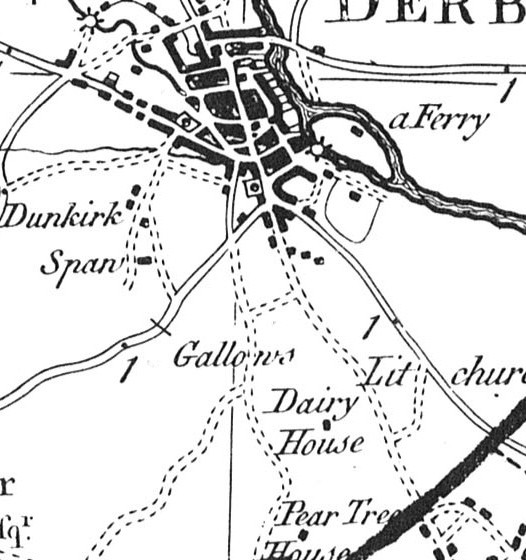
An extract from Burdetts map of Derby in 1791, showing Dunkirk Span, and also a nearby Dairy House [18]
It appears as if 2 acres had been retained with the house, and that the other 7 acres had been rented to Francis Greatrex. Had it previously been his father's tenancy perhaps?
It is proving difficult to reconcile Burdett's map with modern maps of Dunkirk Street which is located just off the A601, adjacent to Dewry Lane. The area was extensively re-developed in the latter half of the 19th Century and is covered with densely brick built terrace housing from that period.
If you happen across this blog, and are interested in any of the topics discussed I will be pleased to hear from you. I would be especially happy to hear from you if you are a local historian in Derby, Littleover, Markeaton or Mickleover if you can help me locate any of the fields discussed above.
I can be contacted on balmer.nicholas@gmail.com
I would like to acknowledge the huge contribution made to this article, which would not have otherwise been possible, by the online British Newspaper Archive run by the British Library, from which all of the newspaper extracts come from, and for the maps from the National Library of Scotland. Paul Klein has also provided a considerable amount of information about William Greatrex children's lives in London.
[1] From https://commons.wikimedia.org/wiki/File:English_Longhorn_cow_and_calf.jpg">https://commons.wikimedia.org/wiki/File:English_Longhorn_cow_and_calf.jpg
[2] From John Farey, View of the Agriculture and Minerals of Derbyshire: with ..., Volume 3 published 1817.
[3] From the National Library of Scotland online OS Map collection.
https://maps.nls.uk/os/25inch-england-and-wales/[3] From the National Library of Scotland online OS Map collection.
[4] My later Greatex ancestors who moved down to Hornsey & Highgate in about 1827 used the spelling Greatex. However, my Derbyshire forebears used the name Greatorex. My Grandfather Reginald Cuthbert Greatex Hancock, used to believe that the name had been acquired because one of his ancestors had been an illegitimate offspring of one of the Hanoverian Royal family probably via Hannah Lightfoot. We now believe that this was a "cover story" to hide the fact that his grandfather, Ferdinand Greatrex, a servant in the house, had eloped with his masters daughter. Researchers into the Greatrex name and its associated Greatorex, and Greatrakes variants which occurred frequently from at least Tudor times in Derbyshire suggest an origin in the Rakes, which were outcrops of lead ore that occur near Buxton and Wirksworth.
[5] Dairying in South West Derbyshire in the late nineteenth century: a study in historical geography. A Master’s thesis by G. A. Tomson. 1986, especially Chapter 2. Although this Thesis is mainly about changes in farming brought about by the railways, it has a good section on the situation earlier in the 19th Century.
[6] The grave supposed to be of King Richard III was dug up in recent years from under a carpark in Leicester.
[7] Derby Mercury, Thursday 17th November 1796.
[8] Derby Mercury - Thursday 2nd February 1792
[10] Derbyshire Courier, Saturday 17th of August 1839.
[11] Staffordshire Advertiser, Saturday 28th of August 1824.
[12] Monthly Magazine, Or, British Register, Volume 53, 1822, page 89
[13] http://www.tbheritage.com/Portraits/Pocahontas.html
[14] Stamford Mercury - Thursday 20 September 1781
[15] Stamford Mercury - Friday 27th October 1786
[16] Derby Mercury - Wednesday 9th May 1827.
[17] Derby Mercury - Friday 8th March 1765.
[18] From an article by Ron McKeown on the Derby Heritage Forum http://www.derbyheritageforum.co.uk/Gallows.html