Showing posts with label Suffolk. Show all posts

Wednesday, 27 May 2020

Botanical walks, can Linnaeus help trace ones ancestors?


Cardamine amara  (left hand plant) collected in June 1838 and Mildenhall now in Birmingham University Botanical Collection

A few years ago, I was the recipient of a totally unexpected email from Gigi Crompton [1] a researcher at the Cambridge Botanical Garden who had read an article that I had posted onto the internet about my great great grandfather, the Revd. Harry Baber. 

Did I know that he had been involved in botanical trips while at Cambridge University?

Harry Baber (1817-1892) in 1840.
The Botanical Garden has been engaged in a project for many years that is trying to measure the changes brought about to the flora of Cambridgeshire due to climate change, and mans modifications to the landscapes. They have been going back through the botanical collections and records held since the 1530's in order to try to determine how many plants had been lost, by comparing the lists with current survey details.

Harry Baber was recorded by Charles Cardale Babington (1808 – 1895), the author of "Flora of Cambridgeshire" (1860)making many trips together out into the Cambridgeshire countryside botanising.
Charles Cardale Babington (1808-1895)

Babington was nine years older than Harry Baber, and had been studying botany under Professor John Stevens Henslow (1796-1861), who was professor of Botany at Cambridge. Henslow had also mentored Charles Darwin, and it is this work that he is best remembered for these days.

It had been Henslow who had put forward Darwin's name as being a suitable companion and botanist for Captain Fitzroy who was about to depart on HMS Beagle.[2]

Records exist both on the notes written on the back of the pressed plant specimens preserved in the Cambridge Botanical Garden and also in sources like the diaries of Charles Babington and notes made by Professor Henslow, which record that Harry Baber had been on some of the trips that Henslow and Babington had made, and these describe the locations and the finds they had made.

The Flora survey listed University Database included details of the following excursions.

Chenopodium rubrum Stretham, H. Baber (Hb CC Babington), Oct.1838, CGE.
Lamium purpureum  Grantchester, H Baber, 6.1837, CGE.
Lythrum hyssopifolia L. Stretham, H Baber, 9.1837, E.
Myosotis ramosissima Pit beyond Observatory, as M.collina flore albo., [var mittenii Baber added in pencil], H Baber, 6.1837, CGE.
Mentha x gentilis var cardiaca (Baber), Marshy field by Finch¹s Walk, Cambridge,.
Rorippa amph. Stretham, H Baber, 7.1838, CGE; near Ely, H Baber, n.d. (but Babington label), CGE;
Trifolium subterraneum Gamlingay, Prof Henslow, H Baber (in pencil), HB Churchill Babington, 1836, CGE.
Sparganium emersum Stretham-fen, as S.simplex, H Baber, 8.1837, CGE.
Veronica agrestis Stretham, H Baber, 30.9.1837, CGE.
Veronica polita Stretham, H Baber, 30.1837, CGE.
Lycopodium clavatum Stretham, H Baber, 9.1837, E.
Minuartia Went with Baber to Madingley...We noticed...Arenaria tenuifolia just come up, in the gravel pit near to the Observatory. 29.5.1837 Bab.Mem.62.
Muscari neglectum Hinton, H Baber, 5,1859, BM.
Oenanthe
Oenan pimpinelloides Wilburton, H Baber, Hb JA Power, 7.1838, 'I call this pseudanifolia, Poll. CE Salmon', & pimpinelloides crossed out. RTE.
Potamogeton compressus Stretham fen, H Baber, 6.1839, det. Dandy & Taylor, UCNW.
Potamogeton gramineus Stretham, H Baber, 1837, det. Dandy & Taylor, CLE.
Pulsatilla vulgaris Gogmagog Hills, H. Baber, May 1837, BM. Cambridgeshire, H Baber, Hb JA Power, 5.1838, RTE.
Gogmagog Hills, H Baber, 1839. ex Hb. F Tansom [?spelling.], YRK:6.
Gogmagog Hills, H Baber, Hb JA Power, 1839, RTE.
Gogmagog Hills, Mr H. Baber in Hb Mrs Atkins, 1839, BM.
Taraxacum palustre Ely, H. Baber, 1839, BM.

For a long time I have been waiting for an opportunity to see if I could repeat some of these trips. It would be important to choose the same time of year as the earlier trips otherwise many of the plants would be dormant and invisible.
Harry Baber had been educated at Westminster School, and matriculated at Michaelmas 1834. He was admitted to Trinity College Cambridge on the 13th of June 1834. He became a Scholar in 1835, and a Bachelor of Arts in 1839 and an MA in 1842.

Although he had gone to Cambridge University in order to take his degree so that he would be able to qualify to go on to take Holy Orders, he does not appear to initially have been intending to study botany. In this he was not alone as Charles Darwin, when he had gone up to Cambridge in 1828, it was only in his second year that he began to attend Professor Henslow's lectures.

These lectures did not form part of the curriculum for either student's degrees, and would have to be paid for separately. The core of the degree course in those days mainly revolved around mathematics largely based on Newton's Principia, or Newtonian Physics and moral philosophy.

Henslow's lectures soon became very successful drawing 60 to 70 people to each event. The attendees included not just students but many senior members of the university, including Adam Sedgwick, and William Whewell. [3]

Babington had attended the lectures for three years, paying for each year, but when he reappeared for the fourth year, Henslow relented and he was awarded a free course.


Carex obrubae, or False Fox-sedge collected at Stretham in June 1838

Professor Henslow was in the habit of holding an annual excursion for the students and other members of the audiences of his lectures which would go to Gamlingay Heath which is located about twenty miles west of Cambridge. Carriages were hired to transport the members of the botany club out to Gamlingay, for those members of the party who did not themselves ride. Wives and sisters of the members were also able to join the excursions, that had a strong social aspect to them.

They became a social highlight of the early summer when the lectures and exams were coming to an end.

Gamlingay Heath from the 1900 Ordnance Survey Map. In the 1830's the heath was more open, with few of the hedges shown, or indeed the brick works.
As the day drew to a close a meal was laid on in a nearby inn, and a band was hired to help the evening festivities along. Between sixteen and twenty people generally attended, at a cost of 12 shillings each. These trips which started in 1827 were so popular that they continued every year until 1852. Other trips were made taking advantage of the River Cam down towards Ely, which would have passed Little Thetford and Stretham, which was Harry Baber's family home.

John Stevens Henslow, (1796-1861)
From 1828 until 1837, Professor Henslow held "Friday Evenings" at his home in Cambridge at which many of the most highly regarded scientists of their day were frequently in attendance as well as his students.

The Modern track onto Gamlingay Heath. In the 1830's the Heath would have been much more open, and was probably given over to common grazing.


Trifolium subterraneum

As Gamlingay is only about 14 miles away from my home and with restrictions on travel slowly starting to lift, I decided to make the journey on Monday 25th May 2020.

I was in search of..

"Trifolium subterraneum Gamlingay, Prof Henslow, H Baber (in pencil), HB Churchill Babington, 1836, CGE"

This is where my difficulties began, because clover in its many forms is very common in England, but this one is different from all of the others in only one key respect only. According to Wikipedia, it is alone amongst all the other clovers in that it seeds under ground.

"Trifolium subterraneum", the subterranean clover which, is a species of Clover "native to northwestern Europe, from Ireland east to Belgium". The plant's name comes from its underground seed development geocarpy, a characteristic not possessed by other clovers. It can thrive in poor-quality soil where other clovers cannot survive, and is grown commercially for animal fodder. There are three distinct subspecies used in agriculture, each with its own ideal climate and soil type, allowing for wide distribution of the plant over varied environments.
 
Subterraneum is the generalist subspecies, and it can be grown in the widest range of environments,is grown in moist areas that are prone to flooding.T. subterraneum brachycalycinum is a more sensitive plant, requiring dry, cracked soil for its germination." 

  • Plants on Gamlingay Heath in May 2020
    While very success as a pleasant walk in a remote part of Cambridgeshire, I am afraid that my skills as a botanist are strictly limited. Lacking the skills of a Babington or a Henslow, I have no idea if the clover I saw was the correct one.

    In my defence,  Trifolium subterraneum has become very rare these days.  The reason for these is that wide scale advances in agricultural improvements during the 1840's and into the 20th Century have altered the soil pH. and fertility out of all recognition since 1839. The soil at Gamlingay is very sandy, but it is a cap only a few feet deep over lying clays. This is evidenced by the presence of 19th Century brick pits and the sites of former kilns on three of the four sides of the woods.

    Improving farmers during the 18th Century like my four x great grandfather Josiah Rodwell had already worked out that by digging up the underlying clays, and mixing the clays with the sands they would produce a very great improvement to the soils fertility, and this increase in fertility wiped out many of the highly specialised plants that had formerly grown on this heath.


  • In 1837 Henslow decided to move his permanent place of residence to Hitcham in Suffolk, only travelling back to the University at Cambridge for the Spring Term, when he gave his lectures.

    It is not known when Harry Baber first began his interest in botany, however it probably arose from his living in an apartment attached to the British Library where his father the Rev. Henry Hervey Baber was Keeper of the Printed Books at the British Library until 1837.  Harry's father also had responsibility for the natural history collection.

    At that time there was no Natural History Museum, and a natural history collection had formed part of the British Museum's collection since 1758 when the Rev. Andrew Planta who had come from Switzerland was appointed Assistant Librarian of Natural History.

    Planta's son Joseph, also worked on natural history as an Assistant Librarian in the Department of Printed Books. In 1814 Joseph Planta accompanied Henry Hervey Baber on his trip to Munich where Baber purchased a major botanical collection from Baron Von Moll.

    The Apartments in the entrance quadrangle to the British Library where Harry Baber lived with his father.  The museum and library entrance was just off to the right of this picture. 
    Both the British Library and the British Museum were located in a single building that stood on the site of the existing British Museum, and Harry who was born in 1817, would have lived with his parents in a flat built in the courtyard to the front of the museum that came with the post of Keeper of the Printed Books.[4]  This would have allowed Harry access to one of the largest collections in Britain at that time.

    The earliest collecting expedition in which Harry is known to have taken part in, that we are aware of took place in April 1837, when he found and example of Arabis turrita which is preserved in the Herbarium at the Perth Museum in Scotland.

    "The Perth collection also includes an example of Grape-hyacinth Muscari neglectum which is recorded as having been collected in Cherry Hinton, in May 1837.

    On "May 29. [1837, Babington] Went with Baber to Madingley.  Lamium Galeobdolon was just come into flower.  We noticed Cerastium arvense in flower, and Arenaria tenufolia just come up, in the gravel pit near to the Observatory.  Leontodon palustre was in flower in Madingley chalk pit."

    The gravel pit at Madingley subsequently became abandoned and overgrown. It now forms the eastern most point in the grounds of the American War Cemetery at Madingley.

    During June 1838, Harry appears to have been staying in his father's rectory at Stretham near Ely, where he was able to collect an example of Carex obrubae, or False Fox-sedge.  He then pressed the sample to dry it. Harry then arranged for the sample to be sent to his friend at the Royal Botanical Garden at Edinburgh, where it survives to this day. [5]

    Stretham is located in the Fens directly to the north of Cambridge, on the main road towards Ely.  During the winter, the village was almost an island, as the surrounding area became flooded by winter runoff from the catchment of the Ouse.  Harry was witnessing one of the last summer's before the installation of a major new steam pumping engine at Stretham would draw down the waters, destroying the wetlands for every, and allowing most of the land to be turned over to arable land.


    Cardamine Amara collected by Harry Baber, July 1838, Mildenhall.
    Harry Baber's time at Cambridge began a year or more after Charles Darwin left.  It is largely due to modern interest in Charles Darwin that the records that allow me to follow Harry Baber's botanical interests have survived.

    It is at this point that from the records of Charles Darwin, that a really intriguing set of connections begin to emerge, and these have deep roots into the Suffolk countryside.

    Some of the most interesting records of Darwin's time at Cambridge come from the anecdotes recorded by my great x 4 uncle the Revd. John Medows Rodwell who was a student at Cambridge at the same time as Darwin. I will further explore these connections in a second blog post which hopefully will follow shortly.

    After leaving University Harry was Ordained as a Deacon at Norwich Cathedral on the 26th of July 1840.  On the following day, 27th July 1840 Harry was appointed curate of Barham in Suffolk.  He had been nominated by the Revd. William Kirby Rector of the adjacent parish of Claydon.


    Revd William Kirby by Spence


    The selection of the Rev. William Kirby as a suitable mentor for Harry Baber as he took up his new role as Curate is an interesting one.  The Revd William Kirby was a very highly regarded lepidopterist.

    Natural History was also a professional interest of Henry Hervey Baber, especially when they were attacking his precious religious texts, his primary interests, as the following letter in John Freeman’s book Life of Rev. William Kirby M.A. Rector of Barham, published in 1852 demonstrates. In this letter dated April 25th 1817, Dr Leach wrote to Rev. Kirby: -

    “Mr Baber also Director of the library in the British Museum, sent me another species that had perforated a manuscript from Mount Sinai”

    The insect was apparent a Dermestides [6] of a type that was hitherto unknown, and it had shot out of the bindings of an ancient text that had been collected from the famous library at St. Catherine's Monastery at Mount Sinai.

    The Dr Leach who wrote the letter was William Elford Leach (1790-1836) Assistant Librarian of Natural History from 1813 to 1822, who worked under Henry Baber at the British Library. [6] 

    The recipient William Kirby of the letter was a natural historian of great ability, who was a member of the Royal Society and the Linnaean Society.  From his rectory in Suffolk he corresponded with naturalists in Sweden and South America. It is not clear from the letter how well if at all he knew Henry Baber, but he was later to become closely related to Henry Baber, when Henry’s son Rev. Harry Baber married Sarah Rodwell. Kirby’s second wife was Charlotte Rodwell, Sarah’s aunt.

    Henry’s daughter Anne Maria was to marry the Rev Philip Freeman the younger brother of the Revd. John Freeman, the author of Kirby’s life. This earlier link is probably how Henry’s children came to meet their respective wives from the Gipping Valley in Suffolk.

    The close nature of the friendship, and that it was maintained over many years is suggested by the following codicil in William Kirby's will (from the Suffolk Record Office) as follows:

    "to my dear friend Ann Maria Baber, daughter of the Revd H. H. Baber late of the British Museum Ten Pounds as a token of my regard" Jan 10th 1844 [7]

    William Kirby and his wife Charlotte paid a social visit to Cambridge and Stretham in January 1841. This is recorded in Freeman's Life of Kirby.

    After spending a week at the latter place (Cambridge) and Stretham very pleasantly, we packed ourselves into the Ipswich Coach.”


    Edward Stanley, (1779 – 1849) [8] Bishop of Norwich

    That the Bishop of Norwich was involved in Harry Baber's early career as a curate is interesting.
    Harry Baber's father Henry Hervey Baber occupied a living that was in the Diocese of Ely, and was located within sight of Ely, which was only about six miles from Stretham. However for reasons that are unclear, Harry was ordained by the Bishop of Norwich located much further away.

    Botany may well have been the reason for Bishop Edward's interest in Harry Baber's career. The Bishop was a very keen botanist.  He became President of the Linnean Society in 1837, and remained so until his death in 1849.  He was also the original Patron of the Ipswich Museum and presided at its opening in 1847. 

    The printed licence from Edward Stanley, (1779 – 1849) [8] Bishop of Norwich appointing Harry Baber to his first curacy is endorsed in handwriting: -

    “You residing at Claydon about half a mile distant being allowed to reside out of the parish of Barham aforesaid on account of the Rector being resident in the parsonage house there.”

    I am by no means an expert on either botany or on the history of natural philosophy as it was described at the time. If you are aware of other information on this subject, or know more about aspects of the above, I would very much like to hear from you.  My email is balmer.nicholas@gmail.com


    [2] Janet Brown, Charles Darwin, Voyaging, pages 117-140.
    See also S.M. Walters & E.A. Stow, Darwin's Mentor, John Stevens Henslow 1796-1861.
    [4] The apartments were all located in two wings of red brick buildings that lined either side of the courtyard in front of the museum. Before the existing library was built, these blocks of apartments were demolished. 
    [5] See http://herbariaunited.org/forum/viewtopic.php?t=12933
    [6]Dermestidae are a family of Coleoptera that are commonly referred to as skin beetles. Other common names include larder beetle, hide or leather beetles, carpet beetles, and khapra beetles. There are approximately 500 to 700 species worldwide.
    [7] Doctor Leach who was six years older than Henslow had recognised Henslow's abilities as a naturalist before Henslow went up to Cambridge. It is very possible that Leach would have shown Henslow the botanical collections inside the British Library.
    [8] E-mail from Greg Finch 02/2001, original of Kirby’s will in Suffolk Record Office.
    [9] Edward Stanley, Bishop of Norwich was also President of the Linnaean Society.

    Monday, 30 December 2013

    The Heath, Great Livermere


    Spinney Lane leading up to Heath Farm Great Livermere.


    It is all too easy to overlook the huge amount of effort that has gone into creating our English landscapes.

    Many of us today drive down the lanes of East Anglia without giving a second thought for the millions of man hours of back breaking toil that was required to turn the surrounding land into productive farmland.

    We are also inclined to believe that our countryside is a never changing place.

    Whilst every day we read in our papers and see in our media tales of climate change and food shortages. These fortunately always seem to occur somewhere else.

    What however we often overlook is that having a surplus of population, climate change, and famine are not a new phenomenon, but one that has stalked our countryside in times gone by.

    We least once before we plundered the fertility of our land to the point where it became desert.

    This is the story of one man's efforts to restore the land to fertility, and to grow food in a time of shortage and acute peril. It is a story of enormous effort and an incredible amount of manual work.

    And where did this all take place?

    In rural Suffolk, at the village of Great Livermere, some five miles north of Bury St. Edmunds.

    The following story, is that of my great great great grandfather Joshua Rodwell, a Suffolk farmer.


    Loading Hay.

    I suppose that like very many other Englishmen starting out on a search into my family history, I expected before I got back very far to find a farm labourer and to become stalled in my research at that point. Imagine my surprise when I found the following report from 1800.


    On Clay and Marle. By Mr. JOSIAH RODWELL, of Livermere, near Bury , Suffolk.
     
    From the COMMUNICATIONS to the BOARD of AGRICULTURE.
     
    The Gold Medal of the Board was voted, to Mr. Rodwell for this Communication.

    BEING informed that you have voted to an excellent farmer in Surrey, justly celebrated for his exertions, a mark of your approbation, it has been suggested to me by some neighbours, who have for twenty-eight years viewed what I have done to improve a poor and almost waits tract of land, to send you, an account of my operations, which I have complied with, trusting that this is the most likely method of inducing others to examine well their soils, and whatever may be found beneath : my practice is confined and limited, but your attention can spread any knowledge throughout the kingdom, and render the exertions of an individual beneficial to a whole nation.

    I wish at present, to call your notice to the effect of, digging and spreading marle and clay upon poor dry heaths, producing fern and gorse, but chiefly ling; originally of small value, at best yielding but a scanty support to ill-fed- sheep.

    The Rev. Mr. Lathbury's father, about fifty years ago, was offered any quantity of this heath. at 4d. Per acre: the farm on which I have been working consists of 1400 acres, 700 of which were of this sort of heath ; it had been occupied by my predecessor, Mr. Garnham, for thirty-fix  years, at the rent of 140l. and never more than 150l. the landlord (Bapt. Lee, Esq.) paying tithe ; nor did Mr. Garnham at that rent do much more than make a living in it.  In 1771 it was valued for raising the rent, and 350l. a year demanded, not tithe-free, at which rent  Mr. Garnham refused it, as did several other farmers,  who examined the land ; and when I engaged  at that rent I was pronounced a ruined man by most of my acquaintance who knew the farm. I had a lease of thirteen years.

    My operations at first were to inclose with thorn hedges, marle or clay, and break up 300 acres of the heath; and in the first seven years of the lease I finished what I meant to improve in that term; I marled or clayed 600 acres, at 70 loads an acre, being 42,000 large tumbril loads.  In this work I employed three teams, two of my own, and one I hired for several years.  It is severe work; and the -second year I lost nine horses, attributed to feeding on pea-straw from the new broken heath, a circumstance that deserves the attention of improvers.

    In the eleventh year of my lease I applied to my landlord for a renewal; on which the farm was valued again by Mr. Hare, the surveyor at Peterborough, and I took a fresh lease of fifteen years, to commence at the termination of my old one, at the rent of 400l.
     
    I immediately clayed and broke up 200 acres more, at 100 loads an acre, 40 bushels per load, inclosing all with quick hedges, and ditches 5 feet wide, and 4 deep ; after this, I improved 100 acres more in the same manner.
     
    In the two leases of twenty-eight years, I clayed or marled 820 acres ; and I have clayed or marled so much over the second time, at 70 loads an acre, that the quantity I have carried in all is very little short of 140,000 loads.

    Upon taking a third lease, I was, in 1798—9, particularly steady to this work, and, in forty- nine weeks and three days, carried 11,275 cubical yards, paying by measure of pits, and not by loads, which were filled and spread by 'four men and a boy, and carted by fix horses and two tumbrils.
    In this business of carrying clay or marle I have practised handbarrowing; the men can make good earnings at 10d. a yard, wheeling it thirty rod; and down to 7d. a yard at shorter distances; and I am much inclined to think, .that if we had workmen used to the operation,, and handy at it, like those employed in navigations, that this method would be of all others the cheapest, especially on heavier soils. But by far the greatest part I have done by tumbrils, the expence of which put out is 5d. a yard for team, and a 2¼d. a yard for labour, and paying for laying picks, wedges, &c. also for stones that rise, increase the whole expence to 8 d. per yard, which is at least  ½d. per yard cheaper than I can do it with my own teams: the reason of which is, that the man who contracts with me drives his own horses, and looks after them; at 8 ½d. per yard, 140,000 yards have cost me £4958 excepting the small proportion hired at ½ d. a yard lower.

    I come now to mention a few circumstances which I hope may tend to render this paper useful to others,, not having the experience which I have acquired, : I shall use but few words, but  they shall be founded on positive experiment, or  attentive observation.

    Clay is much to be preferred to marle on these sandy soils, some of which are loose, poor, and even a black sand. By clay is to be understood a grey clayey loam, some of it brick earth, and all has with vinegar a small effervescence. Marle is & a white, greasy, chalky, substance, that effervesces strongly with acids: I make a universal rule, on a second improvement, to lay clay on the fields marled before, sometimes marle where clay was spread before ; but this not general, as clay answers best on the whole.

    In the tillage of improved lands, I am attentive never to over-crop. My usual rotation has been,
    1. Turnips.
    2. Barley.
    3. Clover, rye-grass, and trefoil, one or two years.
    4. Peas.
     5. Wheat.

    On some I have sown oats on the layer, and omitted peas and wheat, which is more favourable to the land; and I should with longer leases have done more so. Peas, it is true, are an improving crop, but the two coming together are perhaps working the marle too quickly. I have broken some heaths up; and sown oats, and even wheat, designing to improve on the stubble ; but sowing four bushels of oats I have gained but ten, and of wheat not more than three coombs at first breaking.

    The coomb is 1/2 a quarter.  My crops, by managing attentively, have been good; I have had 11½ coombs of barley an acre, and even 14, and these over large fields ; I have had seven coombs an acre of peas over six score acres, and fine wheat after them.

    On 90 acres, clayed 100 loads an acre, I have had after two crops, the one turnips, the other barley, cole-feed, and sold it on the ground for 1000 guineas; then turnips, a famous crop, followed by barley, on 75 acres, 16 coombs an acre; and by bats on 15 acres (poorer land)  10 coombs an acre. These crops are for the soil great; but in general my products have been highly to my satisfaction.
    In regard to other manures, my farm has had the fold of from 40 to 48 score sheep; they manure, one year with another, 150 acres; and I am never without bullocks for increasing. the farm-yard dung. I top fold wheat from the beginning of November till Christmas, and even till February, and venture it on clayed land at the hazards of frosts at sun-rife, which sometimes injures it much, but the effect in general is great.

    Of all mucking, that for turnips pays me best, particularly on clayed land : I know many farmers in Norfolk prefer laying it on for wheat, the turnips to have it at second ; but I prefer the other method.. And let me note, that I use long muck to choose, which I think far better than turning, mixing, and rotting muck; here also are different opinions; I speak only from my own experience. Wheat stubble, I think, should always be whelmed in for turnips.

    I once ploughed in a fine crop of buck-wheat for turnips, and the crop was so much worse than the rest of the field, that they .were not penned regularly for the sheep ; yet, with this disadvantage, the barley, following was better than where the turnips were much superior.
    I have dibbled largely, and with good success, and think it the best method; and I approve much of the drill roller as the next best.

    In tilling these improved lands, it is a common observation in Norfolk, that shallow ploughing is necessary to preserve the pan: I have not found this the case here ; but, on the contrary, that the clay and marle works the better the more soil it has to incorporate with.

    Having thus stated, shortly, the general managements of my improvements, I now come, with your permission, to the general result. Rent will speak this:

    It is stated, that, twenty-eight years ago, the rent of farm was £150 a year, tithe free, and that it was then raised to £350 a year, tithe payable.  I may venture to assert, that, at that rent, without  improvement, it might have so stood on my landlord's rent-roll till doomsday, for a mere living could only be made on it even in good times. But upon my taking the third lease, commencing 1799, it was raised to £600 a year, at the same time that to the full value of £100 a year was taken from it; in other words, the present rent is £700 a year. Thus, while, with the blessing of God, I have done well in the farm, and have put five children into the world out of twelve living, I have added £350 a year to the value of the estate, which, at thirty years purchase, is 10,500; and, relative to the public at large, I may venture to assert, that these 1400 Acres have, in the last twenty-eight years, yielded £30,000 worth more of corn, meat, and wool, than they did in the twenty-eight preceding.  A fact which tends strongly to shew the national importance of improvements in agriculture, and also the wisdom of establishing a public board for promoting and encouraging such exertions as may be deemed laudable.
                                                    I have the honour to be,
                                                                    My Lords and Gentlemen,
                                                                    Your most obedient servant,
    Livermere, near Bury, Suffolk,                                                   Josiah Rodwell
                    Nove. 18th, 1799.
    (The Gold Medal of the Board was voted to Mr. Rodwell for this communication.)


    140,000 cart loads is an awful lot of digging. Carts were much smaller in those days than our current trailers, but must have each carried at least a tonne at a time. Marl weighs about 2.2tonnes per cubic metres, which meant that there has to be a considerable number of holes at Great Livermere to find.

    This proved to be the case when I made a visit out to the farm about a decade ago. They show up even more clearly in aerial photos, with the photos made by the RAF at the end of World War II being particularly clear.


    1945 Aerial photographs showing the dark oval patches caused
    by excavation of marl. [photo courtesy of Google Earth.] 
    Spinney Lane is the diagonal lane running from NW to SE across the photo.

    Indeed the pits in Spring of 1944 were sufficiently deep to be able to provide crews of Churchill AVRE tanks preparing to land in Normandy with valuable training in how to cross major craters. [1] 


    Heath Farm in 1999 still showing clear traces of the Marl Pits.

    The pits are still visible in the fields in 2012, although I have noticed that even over the past decade since I first visited the site that they are being lost very fast as tractors and ploughs have become very much more powerful in recent years.


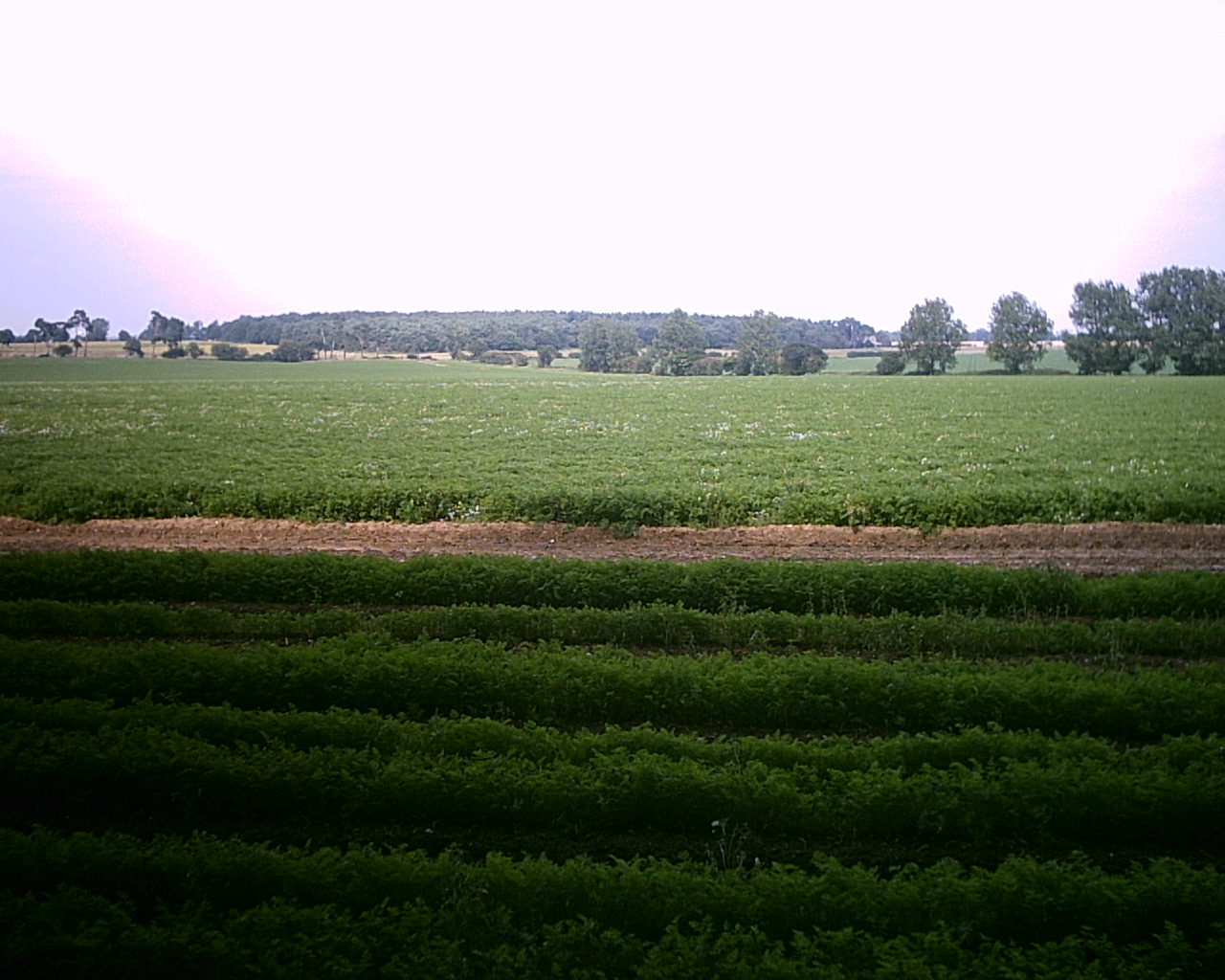
    One of the former marl pits, can be seen in the foreground, as the crops dip down.

    Josiah was married to Elizabeth Medows.  Elizabeth Medows who had been born on March 13th 1751, and she was eventually to die on February 18th 1838 aged 87 at Livermere.

    Josiah Rodwell appears to have been a considerable sheep farmer, before he commenced his arable activities at Livermere. He knew and co-operated with Arthur Young the agricultural journalist, who had been born in 1741 Bradfield in Suffolk.  Josiah was five years younger than Young having been born in 1746.

    Josiah Rodwell had been born on the 5th of October 1746, probably at Mendlesham, where his parents John and Catherine Rodwell lived. His parents seem to have also been substantial tenant farmers, so that it is probable that they had moved in much the same circles as Arthur Young.

    Josiah had started out as a sheep farmer, however the pressures of falling prices drove him eventually to change over to arable farming.


    WOOL
    BURY, Feb. 14, 1787

    At a Meeting of some of the principle Wool Growers near Bury, held this day at the BELL INN, to take into consideration the bill now depending in parliament, relating to wool.

    I.       Resolved, That we consider many of the clauses of the said bill, as injurious and oppressive to the growers of wool.  That it needlessly and wantonly multiplies restrictions, fines, forfeitures, and punishments.  Is entirely adapted to lower the price of wool; but not at all calculated for its pretended purpose, that of preventing the practise of smuggling.

    II.    Resolved, That we do earnestly request the wool-growers in other parts of the country, to unite with us in our endeavours to oppose a measure that would be so generally detrimental; and we hope for the support of all land owners and others in opposing the bill, to procure a county meeting for rendering such an opposition regular and effective.

    III. Resolved, That another meeting be held at the Angel Inn at Bury, on Wednesday the 21st day of this instant February, at Four o’clock in the afternoon, on the said day.


    WILLIAM MACRO,
    JOHN CANHAM,
    EDWARD PUGH,
    JAMES DEEKS,
    WILLIAM STUTTER,
    JOH NUNN,
    J. PYTCHES, Jun.
    JOSEPH PAWSEY,
    WILLIAM ADAMS, Sen.
    JOHN SIMPSON,
    JOHN STUTTER,
    ROBERT HOWLETT,
    JOHN STUTTER, Jun.
    JAMES CLIFT,
    THOMAS COCKSEDGE,
    THOMAS HARVEY,
    W.ADAMS, Jun.
    LEO BIDWELL,
    GEORGE WYARD,
    WILLIAM KEMBALL,
    ROBERT ROPER,
    WILLIAM BROOKS,
    JOSIAH RODWELL,
    J PYTCHES,
    JOHN HARVEY,
    G, CORNELL,
    ROB. LANCHESTER,
    JEREMIAH PAINE,
    JONA. COOPER,
    JOHN WORLLEDGE,
    WILLIAM CORNELL,
    MICHEAL HOUGHTON,
    JOHN FILBY,
    JOHN SPARHAM,
    JOHN WHISTLER,
    R. KEDINGTON.


    Josiah was active in the Suffolk farming community, and corresponded with Arthur Young. Several of his comments appear as footnotes in Young's General View of the Agriculture of the County of Suffolk.

    "The importance of this subject cannot be too much enforced; and it were an object worthy of the Board of Agriculture, to obtain a Bill from Parliament, permitting a general inclosure throughout the whole county, of waste lands.  Where the common consist of good lands, the advantages of converting them to private property, would be prodigious; and the poorest, by being so converted, would, I am persuaded, produce double their present value; whereas, at present, the profit is extremely small indeed.  And whenever a landlord lets a farm with a common right, which is valued with the rest of his premises, I believe every good farmer who makes use of it, would be a loser instead of a gainer." [3]

    He went on to write:

    "The importance of inclosing waste lands, is evident too from another consideration, supposing an equal profit only would be the result: the men who usually reside near a common, are the depredators of the neighbourhood: smugglers, sheep-stealers, horse-jockies, and jobbers of every denomination, here find their abode."


    A Rodwell family tree drawn up in about 1845.  
    [Please click on the image for a larger version.] 


    The farm house at Heath Farm, which we believe Josiah Rodwell built.

    Josiah appears to have been very interested in trees. The garden at Heath Farm contains a number of very large trees including Copper Beech, Wellingtonia and other fir trees, and he planted the magnificent lime avenue that leads up to the farm.


    The trees in Heath Farm gardens.

     
    The Lime Avenue at Great Livermere.

     
    Josiah was an extremely effective tenant farmer, who was extremely fortunate that his career in farming coincided with the French Revolutionary Wars, resulting in a number of years of excellent prices for his crops.  He believed that he had made £30,000 in 13 years, which was more than most of the local landowners would have expected to have made in rents.

    He went on to bring up a large family, of whom several of the boys were able to be sent to Cambridge University, which must have been unusual for this period.
     
    Josiah was also widely employed to value and to sell farms over much of Suffolk, as well as serving on Grand Juries at the nearby Bury Assizes.

     “In his 56th year, Mr. Josiah Rodwell, an opulent farmer at Little Livermere, and highly distinguished for his agricultural knowledge.  He was at Woolpit fair the preceding evening; and, on the morning of his death, was as well as usual.”

    Josiah Rodwell had died on the 21st of September 1802, which was the day after the Fair that was run annually at Woolpit. I hope that he had had a really good time at market.  He was buried at Livermere. [4]

    His memorial was described in 1827 as being at the church at Livermere on the south side.

    “Also a flat stone to Josiah Rodwell late of Livermere Parva who died Sept 21 1802."

    However time seems to have removed the gravestone as despite extensive searches it is nowhere to be seen today, unlike this mans magnificent trees.

    If I could leave a legacy in 200 or more years like the trees that Josiah Rodwell planted, I would be a die a very happy man. You cannot believe the thrill that I felt when I found them.  Much as I enjoy written archives, trees and holes in the ground are also an extremely powerful way to leave ones mark.

    I would very much like the opportunity to visit and photograph Heath Farm one day. I have been unable to find out who owns the house at present.  If you live there and are prepared to let me visit the house and gardens, I would love to hear from you. I can be contacted at balmer.nicholas@gmail.com


    [2] Davy’s Suffolk Collections LXXI, page 80 onwards. Davy, David Elisha (ca.1840) Suffolk Collections.  British Library Add. MSS. 19147. Davy lived from 1769 to 1851 and was both a botanist and antiquarian.
    [3] Young's General View of the Agriculture of the County of Suffolk. Page 167.
    [4] A concise description of Bury St. Edmund's, and its environs, within the Distance of Ten Miles. Published 1827, page 242.


    Saturday, 13 July 2013

    Suffolk law before the police, and the Barking Association


    The Fox, Barking Suffolk 

    Most of us if we go back far enough into our family history expect to find a farming ancestor sooner or later,  and it is often at this point that we get stuck without being able to find out anything further about their ancestors.

    In the case of my Suffolk Moore ancestors this had occurred when I got back to my  paternal 5 x great grandfather James Moore (1765 to 1831), and until recently, I had assumed that this would be as far as I would be able to get.  I thought that he was probably a peasant who had spent his days trudging along in the mud behind a plough, leaving little if any further trace of his life.
     
    Recently I have been really surprised to find him turning up in the scanned local newspapers held on the British Library website. 
     
    What has been great fun to find is that he and most of his closest friends seem to have all been members of the Barking Association that met at the Fox pub in Barking in Suffolk.  

    James Moore rented and ran the water mill at Badley for many years.  He had become the tenant in about 1797, and to have been an active member of the local community, joining the Barking Association.

    This association was one of a very large number of similar associations set up across the country formed by farmers and larger householders and small tradesmen in villages, primarily to raise rewards for information on, or for the capture of thieves, or rick burners.

    In those days there was no police force and such justice as there was, was in the hands of the local Justices of the Peace and of the village Constables. The Constables were ordinary villagers chosen annually, often selected unwillingly, by the parish vestry to try to enforce justice and to apprehend thieves or criminals. They also were expected to collect taxes and were therefore often unpopular with the other villagers and little supported.

    The farmers were generally the richest people living in the villages, with the landlords often living in London, or many miles away.  The farmers often felt themselves to have been under siege from the villagers, and local town poor, as their fields, full of valuable animals including horses attracted the frequent attention of ill disposed, and often semi starving villagers or passing thieves.  The only solution was for the farmers and other members of the community, at this period before the police force had been invented was to club together to offer rewards for the apprehension of thieves and other malcontents.


    An advertisement for the half yearly meeting of the Barking Association.
    The Ipswich Journal, January 30th 1796.
     
     
    All to soon James himself would need to call on the services of the association.


    BARKING ASSOCIATION. WHEREAS some time in the Night of the 18th inst. the Home Barn of Mr, JAMES MOORE, of Badley, was broken into, and a quantity of dressed WHEAT was feloniously stolen from the heap. Any person who shall apprehend, or give information of the offender or offender, so as he or they may be lawfully convicted of the said robbery, will be intitled to and paid the sum of 2£. 10s. out of the public stock of the said Association, by applying to Mr. Sam. Harwood the Treasurer.  And the said James Moore hereby offers a further reward of 20£. to be paid on conviction as aforesaid. 21st Dec. 1801.
    [1]
    It hasn't been possible to find out if anybody was caught stealing the wheat.
    
    The Association would continue to meet at the Fox Inn at Barking for many more years to come, and as the following advertisement from the Ipswich Journal dated Saturday 28th June 1824 shows, both my great great great great grandfather James Moore of Badley, and his sons, James Medows Moore of Darmsden, and John Kirby Moore, of Combs were regular attendees at these dinners at the Fox Inn.


    J.W. Pennington of Combs listed above was Joseph Pennington, a gifted land surveyor, land agent and steward since 1772 for Lord Ashburnham. [2]  He was living at Holly Oak Farm at Combs, and it appears that John Kirby Moore was living at the farm, possibly learning to farm.  In 1831, John married Joseph Pennington's daughter Henrietta. He was later to become steward for Lord Ashburnham.
     
    With the aid of the newspapers, and also records in the Ipswich Records office, I have been able to fill in the backgrounds to many of the other farmers listed above, and they will feature in many forthcoming posts.
     
     
    I find myself imagining them all carousing into the evening around a roaring fire, and although the Fox is nowadays a Chinese restaurant, I hope one day to be able to visit it during opening hours.


    [1] The Ipswich Journal - Saturday 26 December 1801
    [2] The Journal of John Kirby Moore of Badley.  Edited by Michael Durrant, published by the Suffolk Family History Society, August 2001.